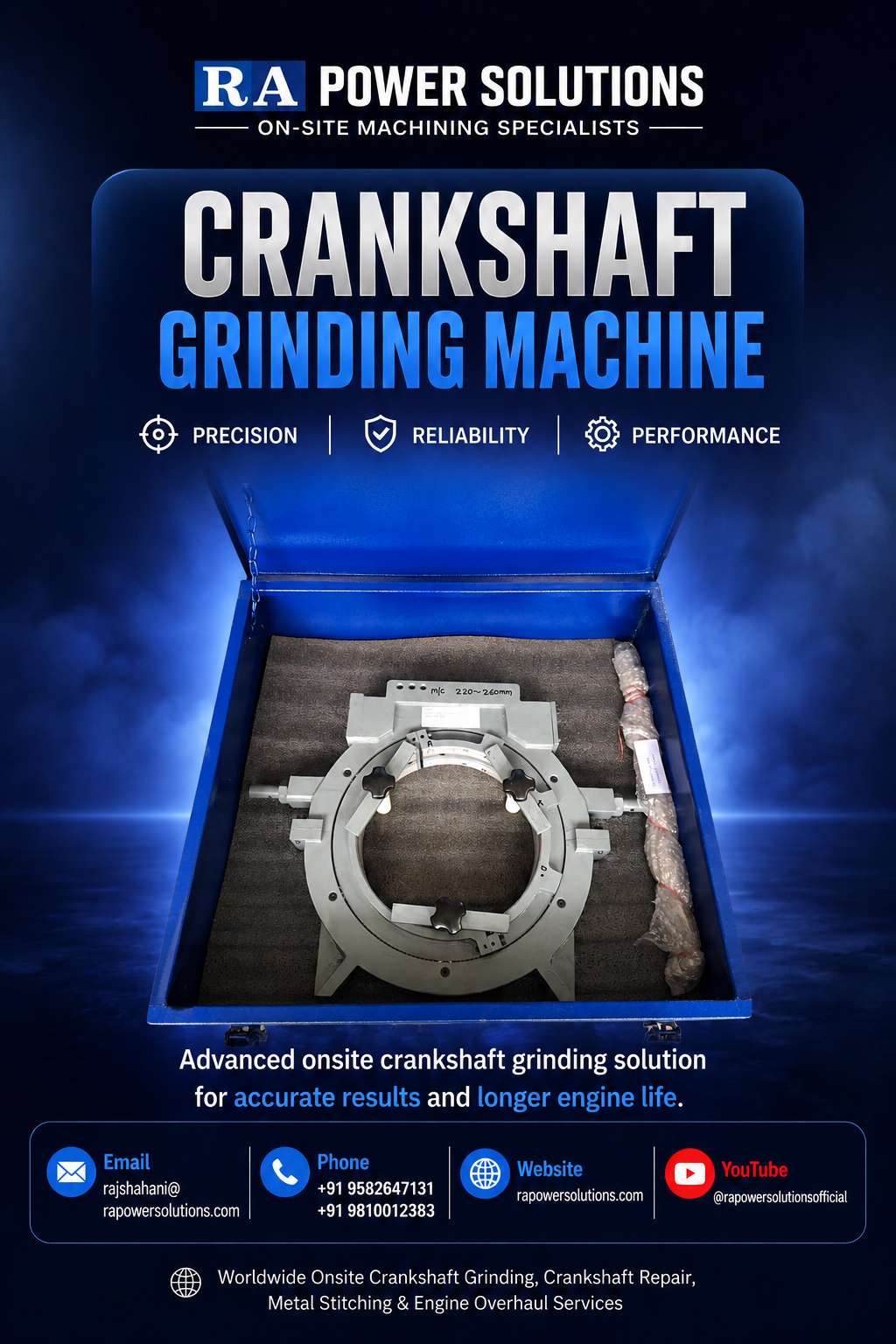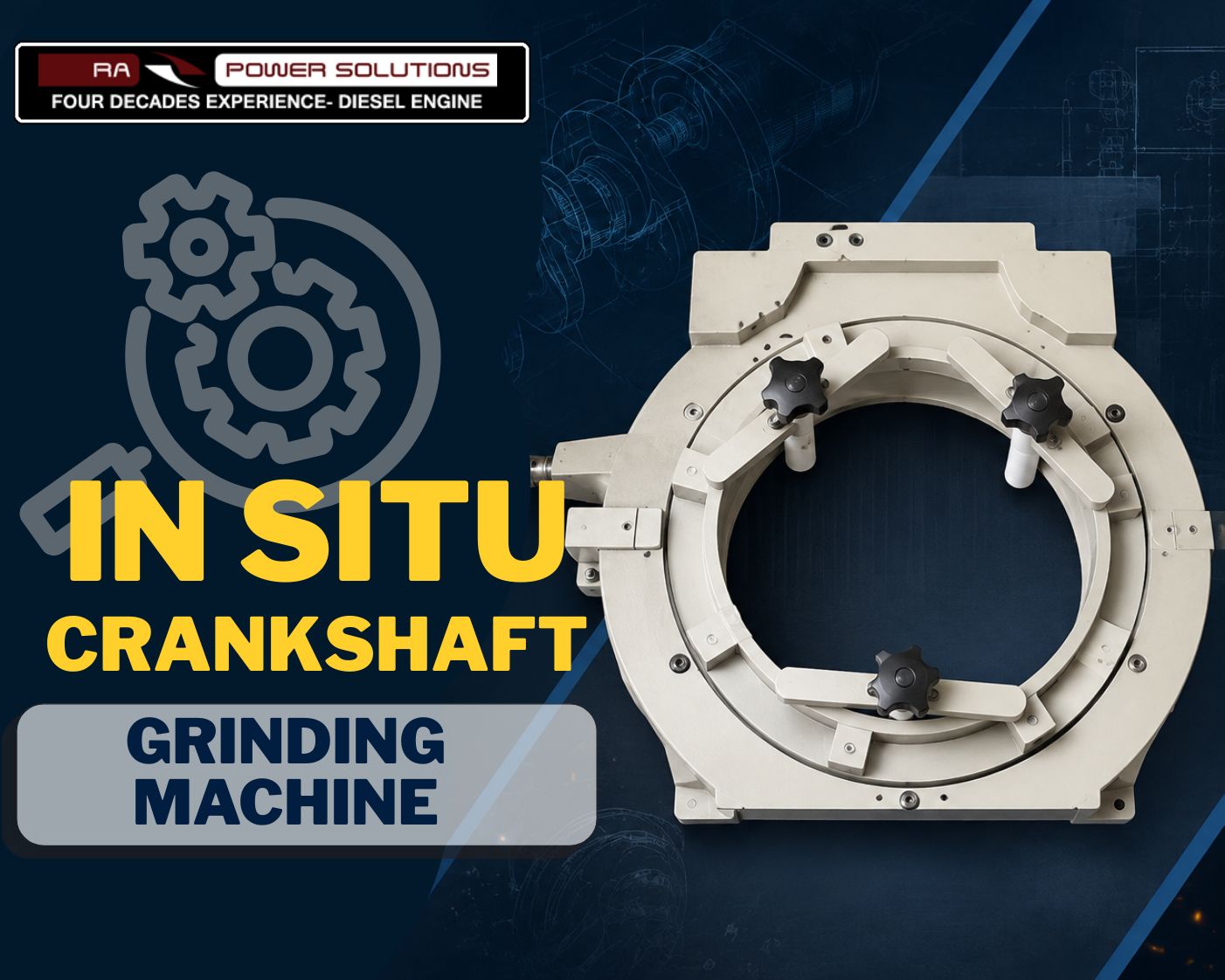
Crankshaft Grinding Machine for In-Situ Crankshaft Grinding Repairs
When we started working on marine diesel engines, crankshaft damage almost always meant one thing—remove the crankshaft, send it ashore, wait for workshop availability, reinstall it, and then complete alignment and sea trials. That process could keep a vessel out of service for weeks. Today, in many cases, we complete the same repair with an in-situ crankshaft grinding machine while the crankshaft remains inside the engine block.
RA Power Solutions has been involved in onboard crankshaft repairs where removing the crankshaft was impractical. Space restrictions inside the engine room, vessel schedules, and the cost of extended downtime often make in-situ machining the only realistic option. The result depends less on the machine itself and more on how accurately it is installed, aligned, and operated.
Why an In-Situ Crankshaft Grinding Machine is Different
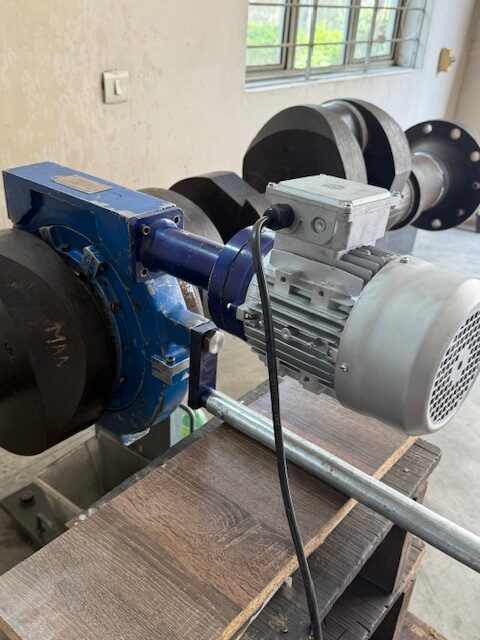
Unlike conventional workshop grinders, an in-situ crankshaft grinding machine is designed to operate directly on the engine. The machine is mounted on the crankshaft itself and travels around the damaged journal without dismantling the engine foundation or removing the crankshaft.
The purpose is straightforward:
(i) Restore damaged crankpins and main journals
(ii) Maintain OEM dimensional tolerances
(iii) Produce the specified Ra surface finish
(iv) Maintain the correct fillet radius
(v) Eliminate taper and ovality
(vi) Restore proper bearing contact
The machine is portable, but the machining standards remain the same as workshop practices.
Why We Use a Crankshaft Grinding Machine Onboard
On many vessels, removing a crankshaft is simply not practical. Limited engine room space, voyage schedules, and the cost of dismantling make onboard machining the preferred option whenever the crankshaft remains within OEM regrind limits.
Using a crankshaft grinding machine allows us to:
(i) Grind crankpins and main journals onboard
(ii) Correct taper and ovality
(iii) Restore the required Ra surface finish
(iv) Maintain the correct fillet radius
(v) Prepare journals for undersized bearing shells
(vi) Reduce engine downtime
Common Crankshaft Defects Repaired
1. Journal Scoring
Scoring generally results from contaminated lubricating oil or inadequate lubrication. Light and moderate damage can usually be removed through controlled grinding.
2. Bearing Seizure Damage
Bearing failure often leaves heat marks, metal transfer, and deep scoring on the journal. Careful inspection determines whether the journal can be reground within OEM limits.
3. Taper and Ovality
Excessive taper or ovality affects hydrodynamic lubrication and bearing life. Precision grinding restores the journal to the specified geometry.
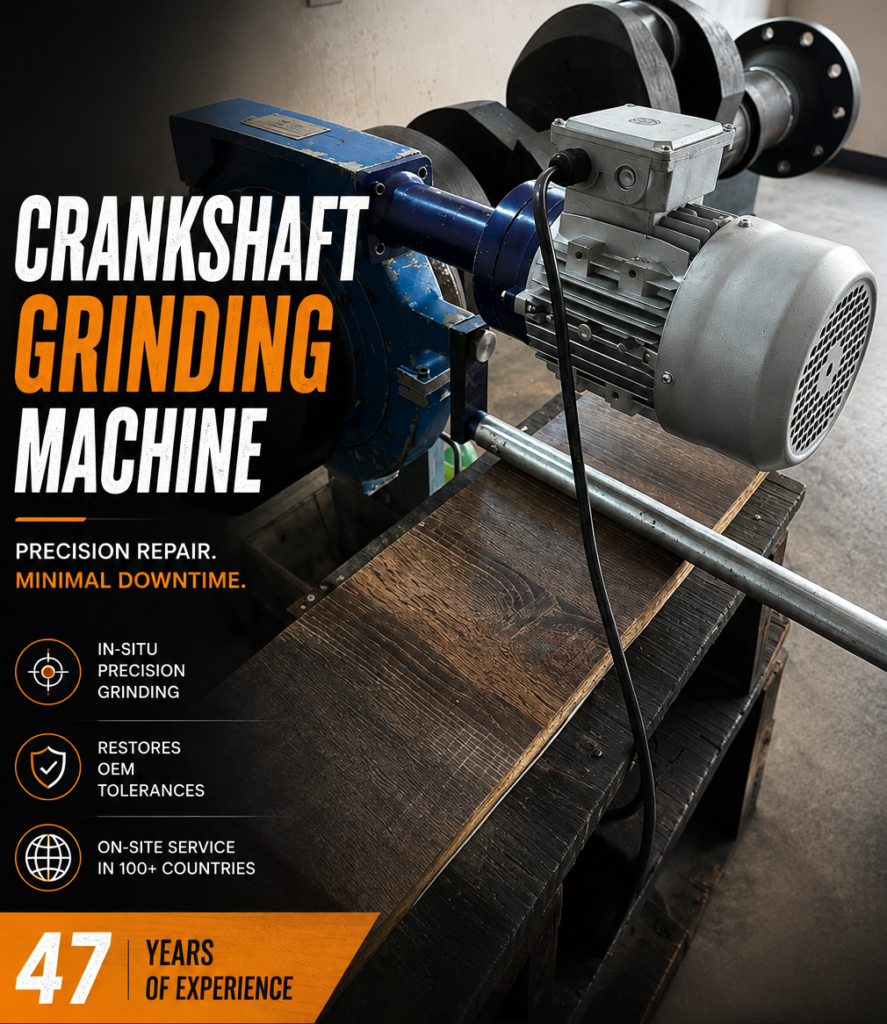
Installation of the Crankshaft Grinding Machine
Proper installation determines the quality of the repair. Before grinding starts, we verify:
(i) Machine alignment
(ii) Journal runout
(iii) Grinding wheel condition
(iv) Feed mechanism accuracy
(v) Lubrication arrangement
(vi) Safety clearances
(vii) Incorrect alignment can affect the final journal dimensions and surface finish.
Grinding Within OEM Tolerances
Maintaining Journal Geometry
Throughout the grinding process, journal dimensions are checked repeatedly to ensure compliance with OEM specifications.
The repair focuses on maintaining:
- Journal diameter
- Roundness
- Taper
- Ovality
- Ra surface finish
- Fillet radius
Surface Finish After Grinding
A smooth appearance alone is not sufficient. The journal must achieve the specified Ra surface finish so that proper hydrodynamic lubrication develops between the crankshaft journal and the bearing during engine operation.
Selection of Undersize Bearing Shells
After grinding, journal dimensions are measured accurately before selecting the correct undersize bearing shells. Proper bearing clearance is verified before final assembly to ensure reliable engine performance.
Drydock vs In-Situ Grinding
In my experience, many crankshaft repairs can be completed onboard without removing the crankshaft. However, if the damage exceeds OEM regrind limits or structural defects are detected, crankshaft removal and workshop repair may still be necessary.
Classification Society Requirements
Crankshaft repairs are generally documented in accordance with the owner’s maintenance procedures and, where required, witnessed by classification societies such as DNV, ABS, Lloyd’s Register, Bureau Veritas, ClassNK, or IRS.
Typical documentation includes:
(a) Initial inspection report
(b) Journal measurements
(c) Grinding records
(d) Surface finish measurements
(e) NDT reports (where applicable)
(f) Final inspection report
Applications of a Crankshaft Grinding Machine
Marine Engines
Repair of crankpins and main journals on main and auxiliary engines.
Power Plant Engines
In-situ grinding of crankshafts used in stationary diesel generator sets.
Industrial Engines
Repair of crankshafts in heavy-duty industrial and process plant engines.
It can be used on both crankpins and main bearing journals when damage falls within allowable repair limits.
Practical Lessons From Onboard Repairs
One thing years of field work have taught us is that successful crankshaft repair is rarely about removing the most material. It is about removing only what is necessary while preserving the crankshaft’s geometry.
Every journal tells a story. Heat marks often indicate lubrication failure. Local scoring usually points toward contamination. Uneven wear can suggest bearing alignment issues or excessive loading. If those root causes are ignored, even a perfectly ground journal may fail again.
A properly installed crankshaft grinding machine for in-situ crankshaft grinding repairs, combined with accurate measurement, controlled machining, and compliance with OEM tolerances, allows many marine crankshafts to return to reliable service without the cost and delay of complete crankshaft removal. The repair is successful not because it is performed onboard, but because the same engineering standards expected in a workshop are maintained throughout the process.
Proven Expertise in Crankshaft Grinding Machine Applications
Using our Crankshaft Grinding Machine (CGM), RA Power Solutions has successfully repaired crankshafts of MAN B&W, Wärtsilä, Sulzer, MAK, Caterpillar, Daihatsu, Yanmar, Deutz, Pielstick, Himsen, Allen, Ruston, ABC, Bergen, Niigata, Cummins, and numerous other marine propulsion, auxiliary, generator, and industrial engine models. Our in-situ crankshaft grinding and repair services have been executed in more than 100 countries, supporting ship owners, offshore operators, power plants, engine manufacturers, and industrial facilities with precision onsite machining solutions.
In addition to in-situ crankshaft grinding, we provide comprehensive inspection, repair, rebabbitting, and manufacturing services for main bearings, crankpin bearings, connecting rod bearings, thrust bearings, white metal (Babbitt) bearings, and engine bearing bushes. Our integrated engineering capabilities enable us to deliver complete rotating equipment and engine repair solutions from a single source, minimizing downtime and ensuring compliance with OEM specifications.
If you require more information about our Crankshaft Grinding Machine, in-situ crankshaft grinding, onsite crankshaft repair, crankshaft polishing, or related engine repair services, please contact our engineering team.
Email: rajshahani@rapowersolutions.com | info@rapowersolutions.com
Phone: +91 95826 47131 | +91 98100 12383